March shareholder meetings to test if firms can finally shake off ‘Kor…
페이지 정보

March shareholder meetings to test if firms can finally shake off ‘Korea discount’
본문


Hiromichi Mizuno (left), a former chief investment officer for Japan’s Government Pension Investment Fund (GPIF), speaks with Kim Woo-jin, a professor at the Seoul National University Business School, at the 2026 Hankyoreh International Corporate Governance Forum, which took place on Feb. 4, 2026, at the National Assembly Members’ Hall in Seoul’s Yeouido neighborhood, with the theme of “How to Approach the ‘Korea Premium’ Era.” (Kim Young-won/Hankyoreh)
2026 Hankyoreh International Corporate Governance Forum | Experts shared their opinions and analysis of what must change in order to end the chronic undervaluation of Korean stocks
In addition to the semiconductor boom driven by investment in artificial intelligence, one factor driving Korea’s benchmark KOSPI index past the 5,000-point milestone was hopes that revisions to the commercial code would improve the backward governance structure at Korean corporations.
But changing a few lines of legislation doesn’t lead to an overnight transformation of corporate governance. Just as the introduction of outside directors on corporate boards — a practice that has worked well in other countries — had risible results in Korea, the goals of reform are prone to being misrepresented and distorted.
That’s why the Hankyoreh hosted an international forum on the topic of “How to Approach the ‘Korea Premium’ Era” before the season of general stockholder meetings in late March. The forum, held at the National Assembly in Yeouido, Seoul, on Feb. 4, was jointly organized by the Hankyoreh Economy and Society Research Institute and the office of Rep. Oh Gi-hyoung, the chair of the Democratic Party’s special committee on the Korean capital market (formerly called the KOSPI 5,000 Committee).
There have been hopes that two revisions to the Commercial Act since July 2025 would cause the winds of change to blow in the business community, but those hopes were deflated by the experts assembled for the forum.
Kim Woo-chan, a professor of economics at Korea University and head of Solidarity for Economic Reform, noted that shareholders still have little authority to counter actions by managers and owners in advance or to hold them accountable after the fact, as well as few ways to proactively exercise their rights.
“We need a medium- and long-term roadmap for reorienting our governance structure from the personal interests of the managers and owning family to the interests of the shareholders,” Kim stressed.
“The Commercial Act revisions were primarily designed to push corporate boards to stop serving as a rubber stamp for management and to take responsibility. That would require directors to communicate with managers and shareholders before the general meetings in March, but I’m worried they haven’t been doing that,” said Oh Gi-hyoung, the lawmaker.
Oh wonders whether board members are considering how shareholders’ rights may be infringed by self-serving corporate practices — such as separate listing of profitable subsidiaries, sweetheart swaps of treasury stocks with other companies, and tender offers set at prices unfavorable to shareholders — that have continued even after the Commercial Act was revised.
Another serious issue, experts said, are legal systems that make it hard for minority stockholders to seek remedies when their interests have been infringed.
“For the revised Commercial Act to have a meaningful impact, shareholders need to sue misbehaving companies, and those rulings need to build up as case law,” said Kim Kwang-joong, an attorney with ClassHankyul. But as Kim observed, “the immense costs of litigation, the years it takes to move through the courts, and the minimum shareholding requirements” stand as serious hurdles to such lawsuits.
Significantly, individual investors are currently expected to personally collect evidence and establish cause-and-effect relationships for white-collar crimes in the capital market such as false reporting, accounting fraud and stock manipulation — which amounts to telling shareholders not to file lawsuits at all.
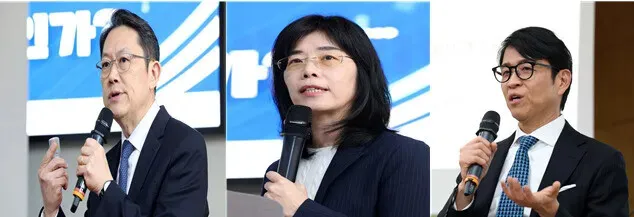
Some experts said it was necessary to clarify the goals of further revisions to the Commercial Act and efforts to toughen “soft laws” such as guidelines and best practices.
“We mustn’t let the debate over corporate governance get stuck in ideological quibbling about ownership,” argued Ryu Young-jae, the president of Sustinvest.
The essential question, Ryu said, is “what governance structure will enable corporations to look further ahead and boldly invest in future competitiveness.”
Lee Sung-won, the head of the environmental, social and governance (ESG) division at Truston Asset Management, observed “evident signs of inefficient capital management,” such as corporations clinging to unnecessary real estate.
According to Lee, tackling this should be a key part of corporate governance reform. He argued that the “Korea discount” is not merely a product of market sentiment, but is also due to corporate governance that lacks an understanding of the “cost of capital.”
Despite the KOSPI’s record-setting gains since last year, 47% of listed companies have a price-to-book (P/B) ratio of less than 0.6, compared to just 6% in Japan and 4% in Taiwan. Lee says that Korea ought to look to Japan, which has succeeded at boosting corporate value since the 2010s by instituting governance reforms at companies with a low P/B ratio.
Another topic discussed in the forum was what role Korea’s National Pension Service (NPS) — a major player in the capital market — should play in corporate governance reform.
“As a long-term investor, the GPIF made clear it needed to work on improving value not only for Japanese companies but also for shareholders,” said Hiromichi Mizuno, a former chief investment officer of Japan’s Government Pension Investment Fund (GPIF).
“Considering that the Korean pension fund controls around 10% of total market capitalization, it needs to act as a ‘universal owner,’” Mizuno argued. In other words, since the NPS controls shares across the capital market, it ought to act in the interest of the entire market.
Won Chong-hyun, the chair of the NPS’ fiduciary council, said the pension service “needs to be prudent and restrained rather than too aggressive” in its exercise of shareholder rights.
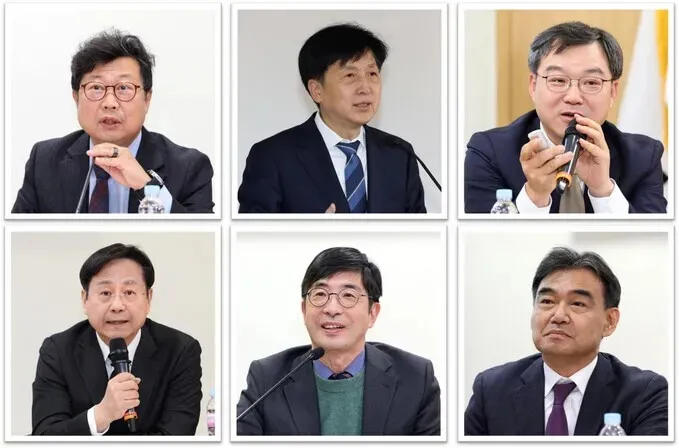
But Won acknowledged that the pension fund’s current approach of resolving problems internally while retaining corporate trust runs the risk of “looking like we’re not doing anything.”
“Research shows that when pension funds engage with corporations, they generally get results through off-the-record, closed-door interactions,” added Kim Woo-jin, a professor of finance at Seoul National University.
Whereas Mizuno emphasized the understated pressure that can be exerted through “soft laws,” Taiwan’s Securities and Futures Investors Protection Center (SFIPC) — which openly and actively defends retail investors — embodies an entirely different approach.
Kim Kwang-joong, the attorney, drew an analogy to how local governments collect taxes for snow removal, recognizing that, in such situations, a freeloader mentality may be more “rational” for individuals than putting the time and effort into shoveling the snow themselves.
In a similar way, Taiwan holds that it’s unrealistic to expect a few shareholders to take on the daunting task of suing corporations and holding them legally responsible, which ends up benefiting everybody. Instead, that’s a “public good” that the SFIPC can provide.
Several members of the forum agreed that this practice may offer insights for Korea, where it’s extremely difficult for shareholders to sue for relief from damages incurred.
Chang Hsin-ti, the head of the SFIPC, advised the Korean government to enact effective and enforceable laws, work closely with prosecutors and courts to reduce information asymmetry between corporations and minority shareholders, sharply lower legal fees to make the courts more accessible, and acquire legal and financial experts to handle class-action lawsuits and similar cases.
By Lee Bong-hyun, research fellow at the Hankyoreh Economy and Society Research Institute; By Kwack Jung-soo, Hankyoreh Economy and Society Research Institute senior staff writer
Please direct questions or comments to [english@hani.co.kr]
관련링크
-
한겨레 관련 기사 링크주소 :
https://english.hani.co.kr/arti/english_edition/e_business/1244783.htm…
307회 연결
- 이전글日本の公的年金、機関投資家のコード履行を牽引する「改革のリーダーシップ」発揮 26.08.06
- 다음글민주 이소영 “‘주가 누르기 방지’ 정부안, 주가 누르기 권하는 황당한 법안” 26.08.05